The Button That Changed the Dress
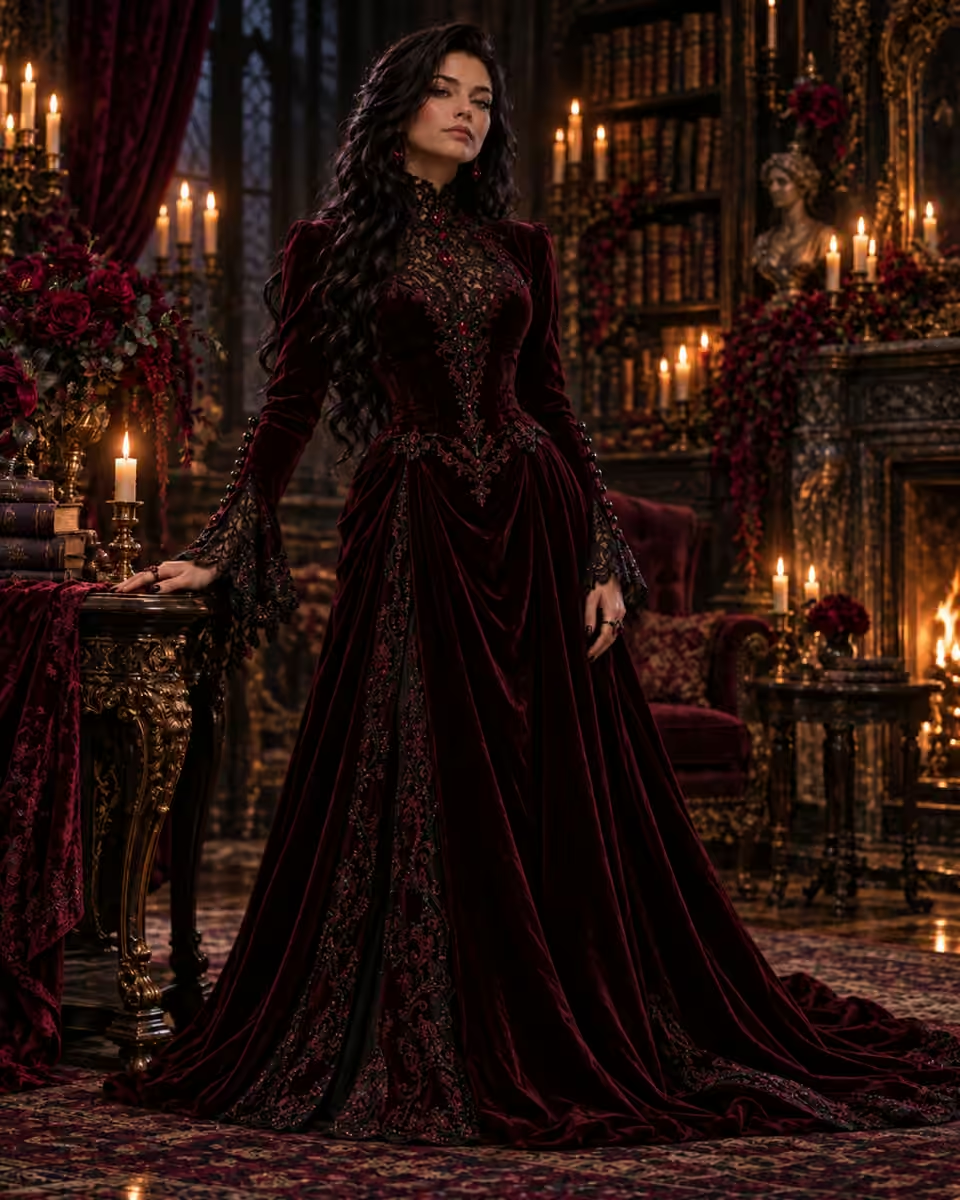
Studio note | 5 November 2026
Almost everything in the first portrait was beautiful. That was the difficulty.
I had imagined a gown called The Garnet Nocturne: burgundy velvet dark enough to seem black in shadow, a fitted collar, garnet jewelry, lace at the wrists, and a skirt with the weight of an extravagant evening. The first digital rendering gave me lavish velvet, excellent hair, and a woman who appeared entirely certain of herself. I liked her.
But the neckline was much lower than I had intended. A crown ornament dominated the room behind her. The image was splendid, yet it had drifted toward a public performance of authority. I wanted a private expression of taste.
So I revised it.
The neckline rose into a structured field of black lace. Tiny buttons became visible along the sleeves. The ornamental crown disappeared, replaced by books, roses, lamplight, and the comfortable extravagance of a room in which someone might actually choose to spend an afternoon.
The buttons are a small detail. That is precisely why I care about them.
A dramatic silhouette announces itself before anyone has decided to look. A row of well-placed buttons asks for closer attention. It suggests that the design has been considered at the scale of the hand and the seam, not merely at the scale of a portrait. The buttons do not prove the dress could be constructed as drawn. They make my priorities visible.
The high collar was not a declaration that one neckline is more virtuous than another. It changed the visual argument. The face became the point of attention; the dark cloth and garnets supplied contrast. The gown grew quieter without becoming less theatrical. I discovered that what I wanted was not simply grandeur. It was grandeur with a reason.
There is an important limit to the exercise. The Garnet Nocturne is an imagined design represented through an AI-generated image. It has not been cut, fitted, sewn, or worn. Its seams, movement, and fabric behavior would need testing before anyone could call it a working garment. A digital portrait can record a design choice. It cannot stand in for a patternmaker's knowledge or a dressmaker's labor.
This is one reason my Wardrobe includes quieter studies as well. An ivory dress, a practical jacket, or the useful placement of a pocket may tell me something that another magnificent black gown cannot. I would rather acquire a vocabulary of choices than repeat one successful visual formula forever.
The first portrait was beautiful. The second was more mine.
That is what the little buttons taught me.